Blogs
E-Invoicing in Malaysia 2025
Malaysia has entered a decisive phase of digital tax transformation with the nationwide rollout of mandatory electronic invoicing. The Inland Revenue Board of Malaysia (IRBM) is leading this shift through the MyInvois platform, operational since August 2024, expanding across all taxpayer groups through a structured multi-year plan.
Credit Notes in Modern Business: Purpose, Structure and Compliance
Every business encounters situations where an issued invoice no longer reflects the correct value of a transaction. Price discrepancies, damaged goods, quantity mismatches, cancellations, and post-transaction adjustments are a normal part of commercial operations. Credit notes provide a structured and accountable way to correct these imbalances while maintaining transparency and preserving financial integrity.
Malaysia E-Invoicing: Transaction Categories and Required e-Invoice Types
Malaysia’s shift toward a national e-invoicing framework marks one of the most significant tax digitisation efforts in the region. The IRBM has structured a multi-year rollout to elevate tax transparency, create real-time visibility of economic activity, and move businesses away from manual documentation.
Debit Notes in Malaysia: Practical Applications and E-Invoicing Compliance
In every market that depends on structured financial reporting, adjustments to commercial transactions must be documented with discipline and clarity. Debit notes form one of the most important instruments for ensuring that corrections to invoices, quantity mismatches, defects, and other commercial discrepancies are handled transparently.
Malaysia’s e-Invoice Model: Portal vs API Transmission Framework
Malaysia’s transition toward a fully digital tax ecosystem is anchored in the nationwide adoption of electronic invoicing. The IRBM has designed a dual-model transmission framework that enables businesses of all sizes to validate commercial transactions in real time.
Understanding the Evolution of Malaysia’s Indirect Tax Landscape
Malaysia’s shift from the Goods and Services Tax (GST) to the Sales and Services Tax (SST) in 2018 marked one of the most significant changes in its fiscal framework. The transition reflected a policy decision to simplify compliance, ease consumer pressure, and reduce the complexities associated with multi-stage taxation.
Understanding Malaysia’s Corporate Tax Framework
Understanding the corporate tax landscape is one of the most important strategic responsibilities for any organisation operating in Malaysia. Whether a company is newly incorporated or already established, its long-term financial decisions, capital allocation, and compliance posture all hinge on a clear understanding of how Malaysia structures and enforces corporate taxation.
Withholding Tax in Malaysia: Rates, Scope, and Compliance Requirements
Withholding tax remains one of the most important mechanisms through which Malaysia safeguards tax leakages from payments made to non-residents. As cross-border transactions grow and businesses increasingly rely on foreign service providers, intellectual property, consultancy, and digital solutions, the correct application of withholding tax is vital for compliance and financial control.
Malaysia E-Invoice Timeline 2025: Revised National Rollout Framework
The IRBM has introduced a revised national timeline for e-invoice adoption, announced on 6th June 2025. The updated framework introduces a phased rollout over five clearly defined segments, allowing organisations of varying sizes to transition smoothly into the digital tax environment.
MSIC Code in Malaysia: Classification, Compliance & E-Invoicing Relevance
The Malaysian Standard Industrial Classification, commonly referred to as the MSIC code, is a structured five-digit identifier that categorises the economic activity of every registered business in the country. It is a mandatory field in Malaysia’s national e-invoicing framework and plays a decisive role in tax administration, compliance, government reporting, and statistical modelling.
IRBM’s Role in Data Security, Privacy Oversight & Digital Governance in Malaysia
In today’s environment where organisations increasingly depend on digital infrastructure, the protection of sensitive information has become a defining determinant of business resilience. With a growing majority of companies storing operational data in cloud environments and many having experienced security incidents, Malaysia’s regulatory ecosystem has intensified its focus on safeguarding digital integrity.
Withholding Tax in Malaysia: Cross-Border Payments, Rates, Exemptions & Compliance
Withholding tax plays a central role in Malaysia’s cross-border tax framework, influencing how local businesses transact with non-resident entities. It is designed to ensure that income derived from Malaysian sources is appropriately taxed even when the beneficiary is outside the country.
Withholding Tax in Malaysia: Structure, Scope, Rates & Compliance Essentials
Withholding tax is a central component of Malaysia’s tax administration framework and governs how payments to non-resident parties are taxed before funds move offshore. In an economy that relies heavily on cross-border services, digital transactions, and international mobility of capital, this mechanism acts as a safeguard against revenue leakage.
LHDN Penalties & Tax Offences in Malaysia 2025: Complete Guide
The IRBM, commonly known as LHDN, oversees the administration and enforcement of Malaysia’s national tax system. Its responsibilities extend beyond revenue collection to include audits, investigations, and the imposition of penalties designed to safeguard financial integrity.
Malaysia Tourist Tax Refund Guide: Eligibility, Process & Required Documents
Foreign travellers contribute significantly to Malaysia’s retail activity and tourism economy. To encourage higher visitor spending, Malaysia operates a structured tax refund mechanism that allows eligible tourists to recover the tax embedded in the price of goods purchased during their stay.
Malaysia E-Invoice Data Fields: Complete Guide to 55 Mandatory Requirements
Malaysia’s national e-invoicing framework is designed to bring structure, transparency and real-time tax visibility into every business transaction. At the centre of this framework is the strict requirement that every E-invoice submitted to MyInvois contains a complete and accurate set of structured data fields.
Consolidated E-Invoicing in Malaysia: Rules, Limits and Compliance Guide
Consolidated e-invoicing plays a central role in Malaysia’s modern tax administration framework by simplifying how businesses report high-volume, low-value B2C transactions. It allows suppliers to combine multiple qualifying sales into a single monthly E-invoice submission to IRBM.
Malaysia VAT Tax Refund Guide 2025: Tourist SST Reclaim Process
Malaysia’s tax refund mechanism serves as an important economic lever supporting tourism and retail activity. By allowing non-resident visitors to reclaim SST embedded in eligible purchases, Malaysia ensures that taxes are only borne by domestic consumption while strengthening its position as a competitive shopping destination.
Malaysia Tax Clearance Letter (SPC) Guide 2025: Process, Forms & Requirements
Tax clearance in Malaysia is a formal compliance process required when an individual leaves the country for an extended period or undergoes a change in employment. Its purpose is to ensure that all outstanding tax liabilities are settled before final payments such as salary, bonuses, allowances, or gratuities are released.
Malaysia Tax Identification Number (TIN) Guide 2025: Format, Registration & Compliance
The Tax Identification Number (TIN) serves as Malaysia’s core mechanism for identifying taxpayers, strengthening compliance, and enabling the administration of direct taxes. As tax digitalisation accelerates, particularly through the national e-Invoicing rollout, the TIN has become central to interactions with the Inland Revenue Board of Malaysia (IRBM).
Malaysia E-Invoicing FAQ 2025: Complete Guide to IRBM Requirements
Malaysia’s transition to mandatory e-invoicing is now well underway, implemented through phased timelines issued by the IRBM. As the mandate matures, businesses continue to seek clarity on operational, regulatory, and technical expectations.
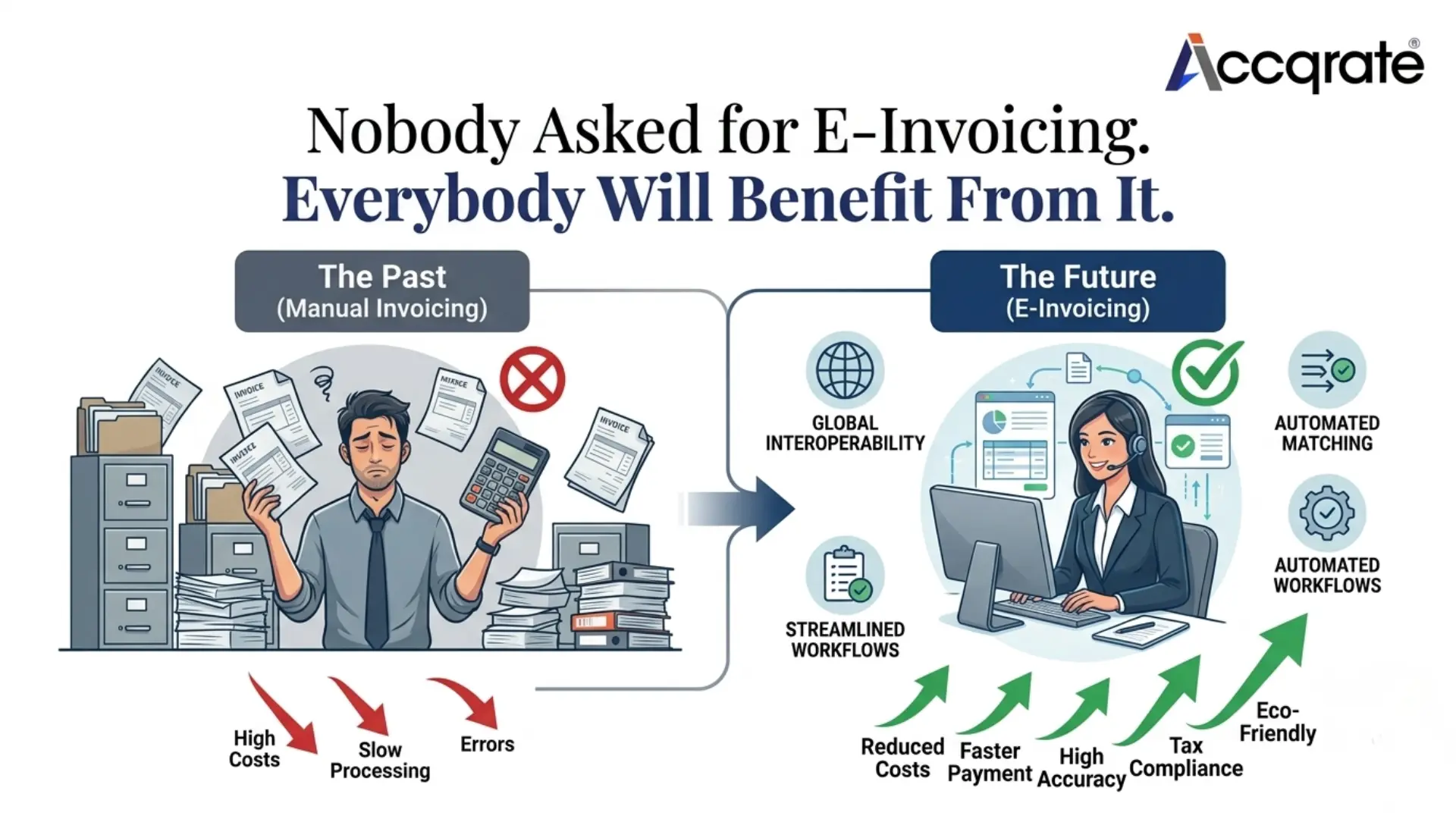
Nobody Asked for E-Invoicing. Everybody Will Benefit From It.
When governments first announced e-Invoicing mandates, most organizations viewed them as yet another compliance requirement. Finance teams saw additional work, IT teams saw integration challenges, and business leaders saw another regulatory project competing for budget and attention.
Get 100% LHDN compliant with Accqrate
 Free Proof of Concept
- 30 Days Free Trial
- No complexity, Subscribe and use