E-Invoicing in Bahrain: Where the Framework Stands and What Applies Today
Bahrain has not yet introduced a mandatory e-invoicing regime for business to government, business to business, or business to consumer transactions. A structured, nationwide system is under active development, but the National Bureau for Revenue has not published a confirmed effective date or a finalized technical specification. For businesses trying to plan ahead, the more useful question is not when the mandate arrives, but what invoicing obligations already apply today and how those obligations are likely to evolve once the framework is confirmed.
The Direction of Bahrain's E-Invoicing Framework
The National Bureau for Revenue is the tax authority responsible for VAT in Bahrain and the lead body shaping the country's e-invoicing framework. Current expectations point toward a phased rollout that prioritizes large taxpayers first, with structured invoice data, likely in XML or JSON format, submitted to the NBR either directly or through a central portal.
Businesses are already permitted to issue electronic format invoices, including PDF invoices, without needing prior NBR approval. This flexibility is a preparatory step rather than the mandate itself, and businesses should continue monitoring NBR communications to stay ahead of the eventual shift to a formal e-invoice format.
What a Compliant Tax Invoice Must Include Today
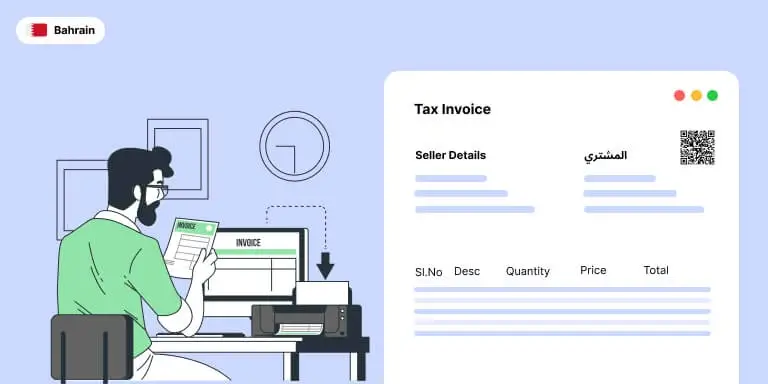
Regardless of how or when the e-invoicing mandate takes effect, VAT registered businesses in Bahrain are already required to issue a proper tax invoice for every taxable supply. A compliant invoice must include the following elements.
A clear label identifying the document as a VAT invoice or tax invoice.
The supplier's full name and address.
The supplier's VAT account number.
The customer's full name and address.
A sequential VAT invoice number.
The date of issue, and the date of supply where this differs from the issue date.
A description of the goods or services supplied, along with quantity and unit price, expressed in Bahraini dinars.
The value of the supply excluding VAT, the applicable VAT rate or rates, the VAT amount shown per line where different rates apply, and the total amount inclusive of VAT.
Where a foreign currency has been used, the exchange rate applied to convert the transaction into Bahraini dinars.
A clear statement where the supply in question is exempt from VAT.
Recordkeeping and Audit Readiness
Beyond issuing a compliant invoice, VAT registered businesses must retain their invoices and related records so they are available for inspection by the NBR. This obligation exists independently of the e-invoicing mandate and applies to every taxable person operating under Bahrain's VAT law today. Businesses that treat invoice recordkeeping as an ongoing discipline, rather than something addressed only at audit time, are better positioned to respond quickly to NBR requests without operational disruption.
Penalty Exposure Tied to Invoicing
Even though the full e-invoicing mandate is not yet active, businesses remain fully exposed to the existing penalty framework under Bahrain's VAT law wherever invoicing and recordkeeping obligations are not met. These penalties apply broadly today and are likely to extend, and potentially expand, once structured e-invoice submission or real time reporting becomes mandatory.
Once the formal e-invoicing rules take effect, particularly if they introduce structured submission or real time validation requirements, failure to meet those e-invoice issuance or transmission obligations will likely be treated as a breach of the underlying VAT invoicing rules. This means such failures would fall under the existing administrative and criminal penalty structure, or under new, enhanced fines introduced specifically for e-invoicing non-compliance.
Key Take-away
Bahrain's e-invoicing framework is still taking shape, but the underlying invoicing discipline it will formalize is already a legal requirement today. Businesses that build strong invoice accuracy, complete recordkeeping, and audit readiness into their operations now will have far less to change when the mandate is confirmed. Solutions like Accqrate help businesses maintain this level of invoicing accuracy and compliance readiness well ahead of Bahrain's move to mandatory e-invoicing.

cta.title1
cta.description1cta.description2 cta.badge2cta.badge3
Recent Blog Posts from Accqrate
Bahrain`s Move Toward Electronic Invoicing: A Strategic Shift in Tax and Economic Governance
Bahrain`s E-Invoicing Regulations: A Comprehensive Guide to B2G and B2B Compliance
E-Invoicing in the Middle East